31 May 2026
Mapping Opponent Tendencies via Bet Sizing Patterns in Multiway Hold'em Pots
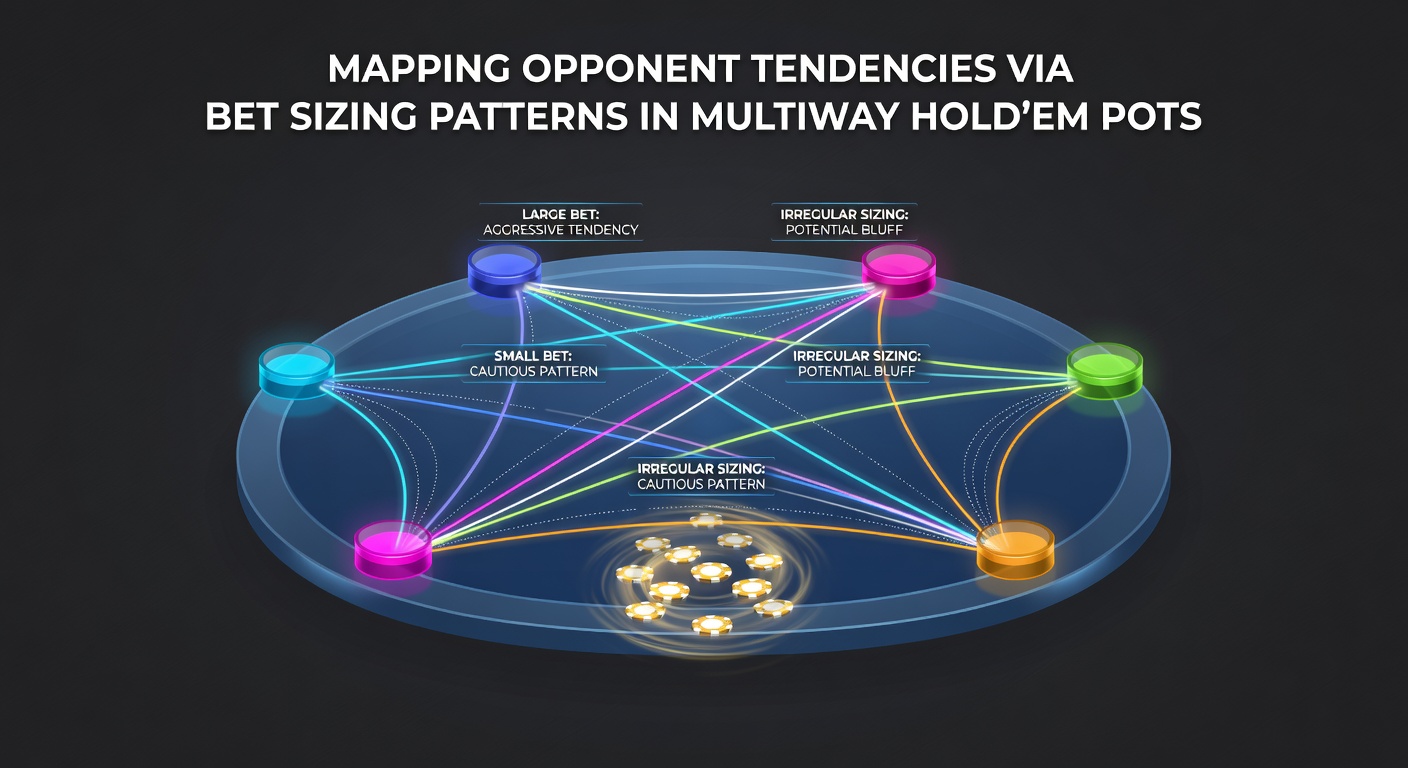
Multiway pots in Texas Hold'em create distinct environments where bet sizing serves as a primary signal for player tendencies, and analysts track these patterns through hand histories and software tools to build profiles without direct confrontation. Data from regulated platforms shows that players in three-or-more-way pots adjust their sizing based on position, stack depth, and perceived range strength, yet consistent deviations emerge when certain opponents face pressure. Observers note that small continuation bets on coordinated boards often indicate a merged range, while larger sizes correlate with polarized holdings in tracked sessions.
Understanding Bet Sizing Signals in Shared Pots
Bet sizing functions as an information leak because players rarely randomize their choices perfectly across thousands of hands, and researchers have documented repeatable clusters such as 25-33% pot bets on flops with multiple callers. Those who study database exports find that loose-passive participants tend toward smaller sizes to control the pot, whereas aggressive regulars deploy larger bets to deny equity when out of position. This distinction sharpens in May 2026 reports from North American operators, where multiway frequency rose alongside increased recreational traffic on mid-stakes tables.
Position further modulates these patterns; early-position bettors who follow through with consistent one-third pot sizing across different board textures often hold medium-strength hands rather than nuts or bluffs. In contrast, late-position actors frequently size up when they hold the betting lead, creating exploitable asymmetries that database miners catalog for later review. Figures from industry tracking services reveal that such positional sizing tells appear in roughly 18% of multiway showdowns when sample sizes exceed 50,000 hands per player.
Common Patterns and Their Interpretations
One recurring tendency involves overbetting on the river after checking the turn in multiway scenarios, and this line often signals a missed draw or a thin value hand rather than a balanced range. Players who adopt this approach against multiple opponents expose themselves because the probability of facing resistance increases with each additional caller. Analysts cross-reference these spots with prior action to separate recreational patterns from professional ones that attempt to balance frequencies.

Small bet sizing on dry boards after a preflop raise frequently represents a blocker or a weak made hand, while the same size on wet boards suggests a draw or marginal value. Those who review population data across multiple sites observe that European players tracked through Malta-regulated rooms exhibit slightly larger average bet sizes in multiway pots compared with North American cohorts, a difference attributed to varying rake structures and player pools. Such regional variations allow for tailored adjustments when opponents migrate between platforms.
Tools and Data Sources for Pattern Recognition
Software that aggregates hand histories enables users to filter by pot size, number of players, and exact bet-to-pot ratios, producing heat maps that highlight deviations from population norms. Regulatory filings from the Nevada Gaming Control Board indicate steady growth in online poker volume through early 2026, supplying larger sample sizes for statistical validation of sizing tendencies. Academic studies published by institutions such as the University of Alberta's poker research group further quantify how bet sizing correlates with hand strength in simulated multiway environments.
Cross-site tracking becomes relevant when players participate on multiple skins, and reports from Australian regulatory bodies show that bet-size clustering remains stable even when stakes change, provided the player pool composition stays similar. This stability permits construction of profiles that transfer across venues, though sample-size requirements increase when opponents adjust their sizing mid-session to counteract known reads.
Application in Live and Online Settings
Live games present fewer hands per hour, yet observers record physical tells that accompany bet sizing choices, such as hesitation before small bets or quick large bets that indicate strength. Online environments supply volume but require careful filtering for multiway-specific data because heads-up situations dominate many tracked databases. Integration of both formats allows for confirmation of tendencies; for instance, a player who consistently uses small sizes online may exhibit the same restraint in live multiway pots when tracked over sufficient sessions.
Case examples drawn from public database reviews illustrate players who shift from 40% pot bets to 70% pot bets precisely when the number of callers exceeds two, a pattern that narrows their range to value-heavy combinations. Those compiling such observations update profiles quarterly to account for strategic evolution, particularly as solver outputs influence recreational players through training sites and coaching materials.
Conclusion
Bet sizing patterns in multiway Hold'em pots supply measurable data points that, when aggregated, reveal opponent tendencies across positions and board textures. Regulatory statistics and academic modeling continue to expand the available datasets, while software tools convert raw hand histories into actionable profiles. Observers who maintain updated records can therefore anticipate adjustments and respond with calibrated counter-strategies grounded in observed frequencies rather than assumptions.